

Overview
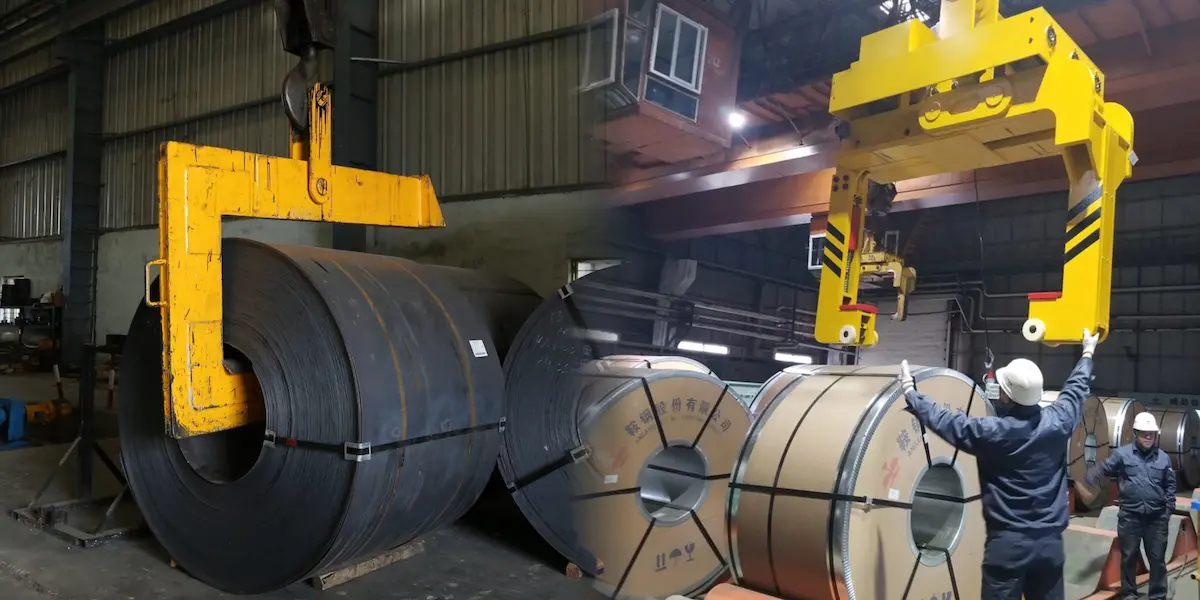
Steel coils are handled frequently in steel production, warehousing, processing, and logistics transport. They are heavy and come in many specifications. Ordinary hooks, wire ropes, or slings are often cumbersome to operate. Positioning is inconvenient, and they easily damage coil surfaces. For this reason, C-hook and steel coil tong are common dedicated spreaders in steel coil handling. A C-hook supports a coil by inserting its load arm into the coil’s inner diameter. It suits horizontal transfer and stacking. A steel coil tong grips the coil’s outer side with jaws. It can handle both horizontal and vertical positions. When selecting steel coil handling equipment, do not look only at tonnage. Also check coil inner diameter, outer diameter, width, placement direction, operating frequency, and crane configuration. Below, we explain their structures, principles, applications, and differences. We also give selection and maintenance advice. This helps you avoid detours in actual working conditions.
Are you choosing the right lifting spreader for steel coil handling?
Different coil sizes, weights, and handling directions affect spreader design and selection. HSCRANE provides C-hook and steel coil tong solutions. We can match suitable equipment to actual working conditions. Contact us to discuss your steel coil handling needs.
[Click here to contact HSCRANE]
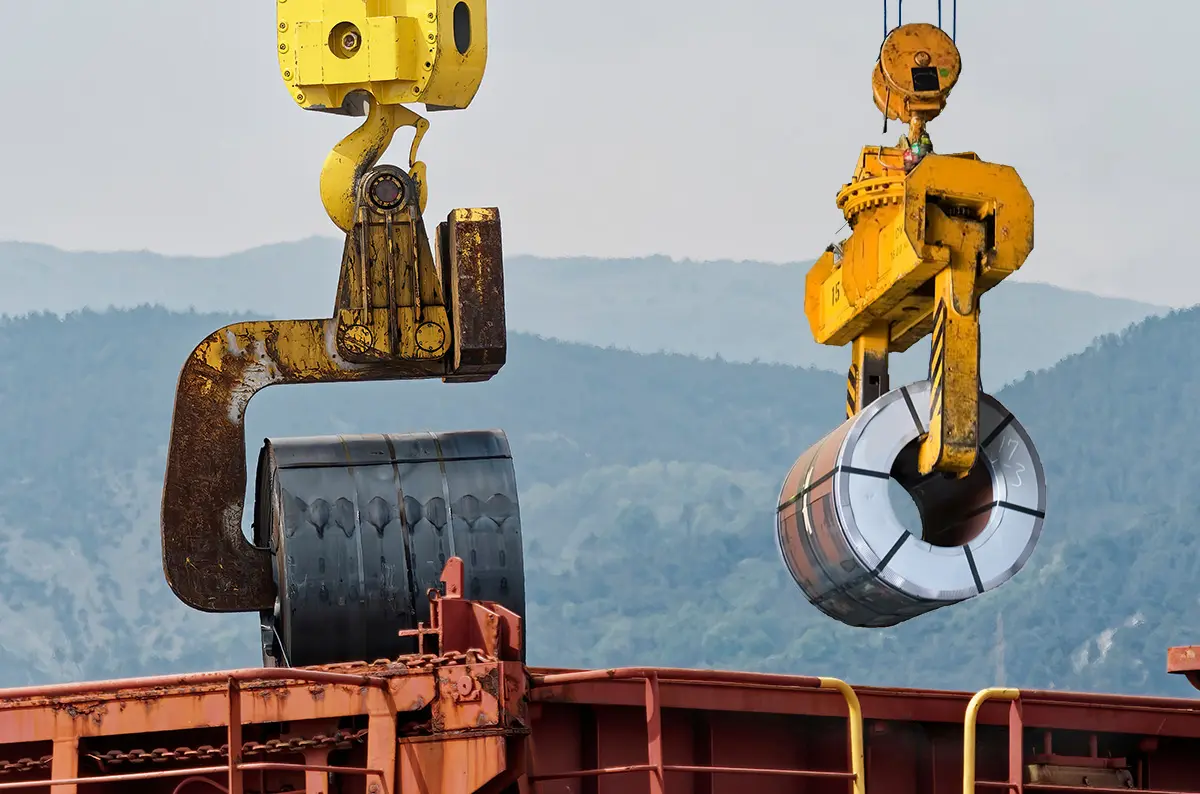
What Is a C-hook? Working Principle and Structural Features
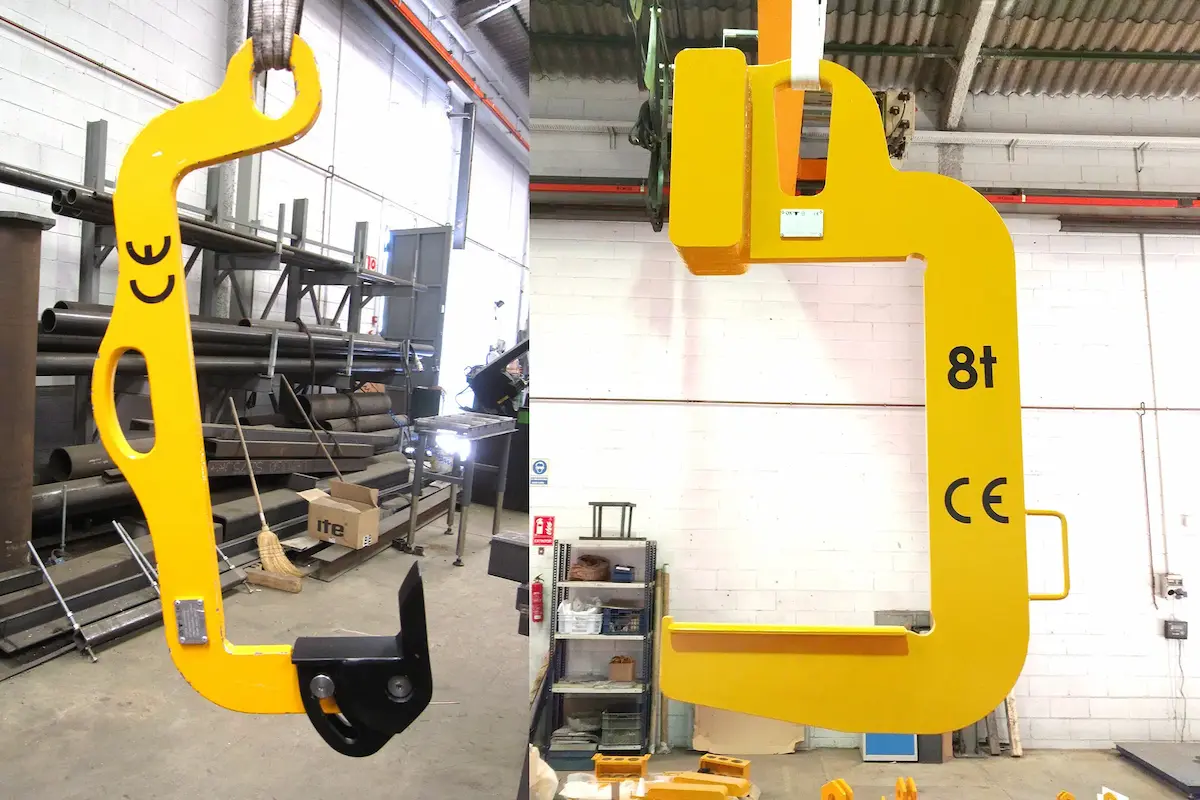
Basic Structure of the C-hook
●C-shaped main body: This is the hook’s “frame,” usually welded from thick steel plates or machined as one piece. Opening direction, section size, and weld quality directly determine support stability. For long-term high-frequency use, pay close attention to rigidity.
●Load arm: This part actually enters the coil inner diameter and bears the weight. Its width and thickness must match the inner diameter and coil weight. If too thin, the contact area is small and the coil may sway. If too thick, it may not enter coils with small inner diameters.
●Counterweight structure: It helps the hook stay balanced when empty. Under load, it offsets eccentric torque and reduces forward tilt and swing. The counterweight must match hook weight, load arm length, and common coil weight. It is not just adding a piece of iron.
●Lifting connection parts: These include lifting lugs, pins, shackles, or special connection seats, with concentrated forces. During selection, confirm they match the crane hook and lifting beam. Do not wait until the equipment arrives to find they cannot connect.
●Size customization: A C-hook is generally not a fully universal component. First confirm the common coil inner diameter range, maximum coil width, and single coil weight. Then set load arm length, opening size, and counterweight. Avoid the problem of “lifting large coils but being unstable with small coils.”
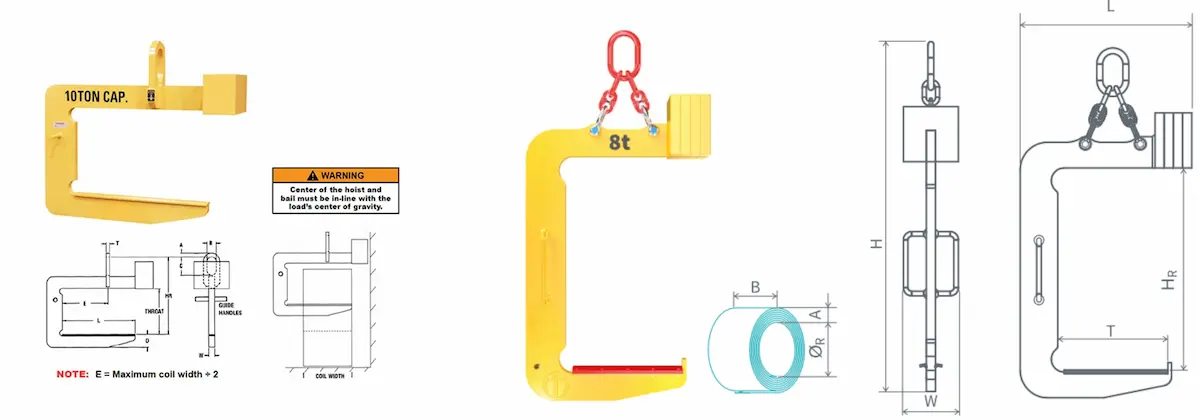
Working Principle of the C-hook
●Lower into position: The crane moves the C-hook above the coil and then lowers it slowly. At this stage, operators must clearly see the load arm and coil inner diameter positions. Do not rush to lower it all the way.
●Insert into the inner diameter: The hook’s horizontal load arm enters the inner diameter from one coil end. Put simply, a C-hook does not “grip” the coil from outside. It “supports” the coil from inside. So smooth insertion and sufficient contact after insertion are key.
●Support at the inner diameter: After the load arm is in place, the crane lifts. The coil weight falls on the load arm through the inner diameter, enabling horizontal lifting. Contact area and insertion depth must be suitable. Too shallow causes eccentric load; too tight reduces loading efficiency.
●Counterweight balance: During lifting, the counterweight helps the spreader and coil stay balanced. It reduces C-hook forward tilt or coil sway. One reminder: the counterweight matches common working conditions. If temporary lifting differs greatly from design conditions, balance may change. Operate more carefully then.
●Transport and unloading: After the coil reaches the target position in steel coil handling, the crane lowers. The load arm withdraws from the coil inner diameter to complete unloading. The whole action looks simple. But it requires smooth lifting, lowering, and travel. In storage stacking areas, insufficient positioning accuracy increases difficulty.
Main Application Scenarios for the C-hook
●Hot-rolled coil production line: Hot-rolled coils are heavy, hot, and produced at a fast pace. C-hook support from the inner diameter suits horizontal coil transfer. However, under high-temperature conditions, confirm spreader materials and protective measures in advance. Do not force ordinary room-temperature spreaders into use.
●Cold-rolled coil processing workshop: Cold-rolled coils require higher surface quality. A C-hook mainly contacts the coil inner diameter and is less likely to touch the outer surface. It suits horizontal handling that needs surface protection. Of course, load arm contact areas also need protection and inspection.
●Steel coil storage and stacking areas: In warehouses, coils often need horizontal placement, stacking, and retrieval. A C-hook works smoothly with an overhead crane. We have seen some narrow warehouse aisles. Hook opening direction and counterweight status directly affect visibility and placement efficiency.
●Steel logistics centers and loading docks: These sites have many coil specifications and frequent turnover. A C-hook suits loading, unloading, and in-warehouse transfer of horizontal coils. During selection, list common coil inner diameters and maximum coil widths. Do not choose a “universal hook” by maximum tonnage alone.
●Handling conditions requiring a horizontal position: If the process requires coils to stay horizontal during lifting, a C-hook is suitable. Conversely, the site may often turn coils from horizontal to vertical. Incoming positions may also vary. In these cases, do not focus only on the C-hook. Include the steel coil tong in the comparison.

What Is a Steel Coil Tong? Working Principle and Structural Features
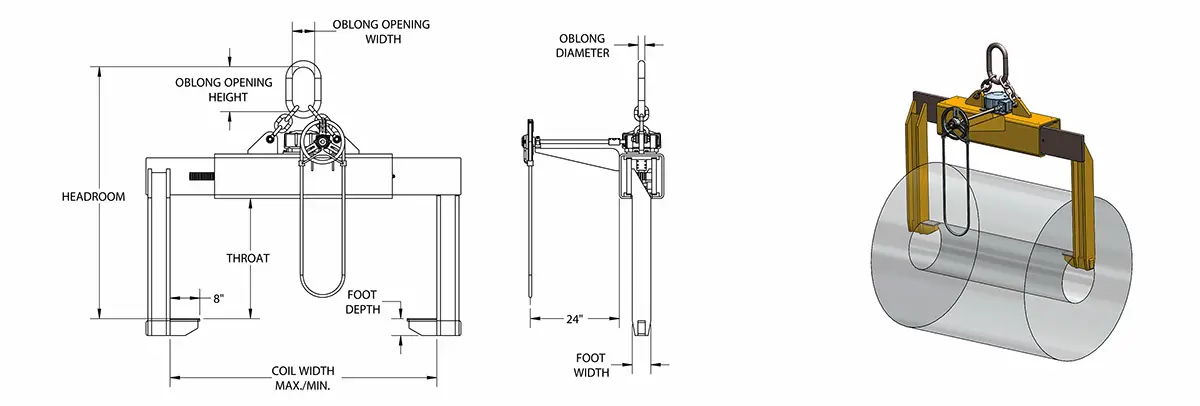
Basic Structure of the steel coil tong
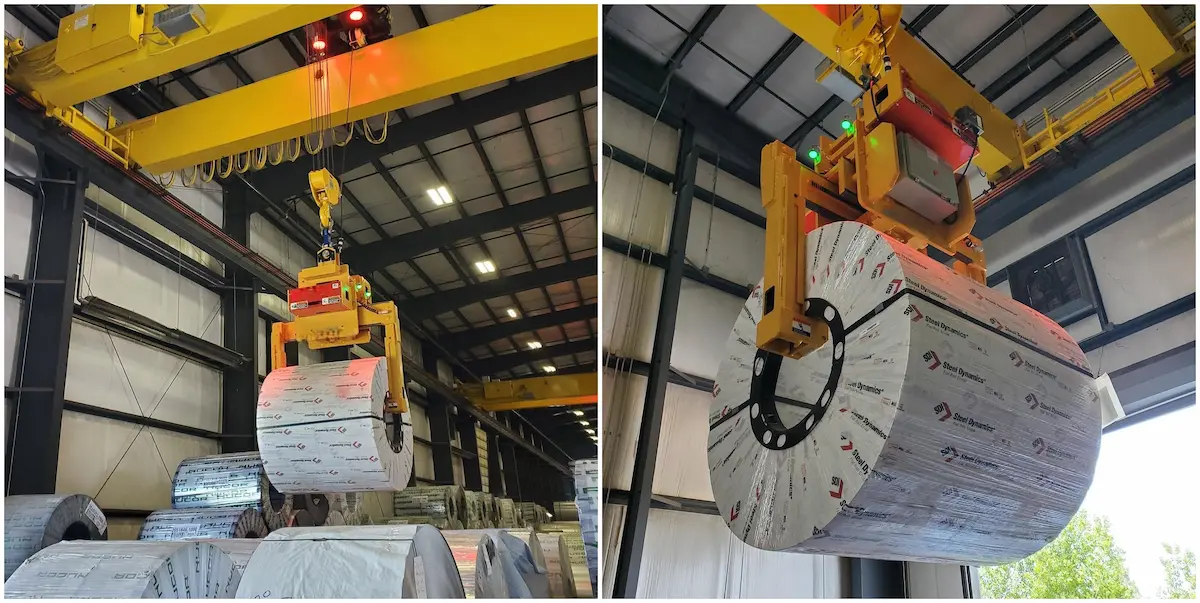
●Clamping tong main frame: It acts as the “shoulder” of the steel coil tong. It must carry the jaws, drive mechanism, and coil weight. If the frame is not rigid enough, it deforms during clamping. Over time, jaw alignment will worsen.
●Electric clamping mechanism and jaws: This is the core action part. It drives jaws to open and close and directly contacts the coil outer side. Jaw stroke, closing speed, and clamping force range must match common coil diameters and widths.
●Clamping contact surfaces and protection pads: Jaw contact areas usually have protection pads, polyurethane plates, or protective coatings. These prevent coil surface indentations. Replace worn pads promptly. Otherwise clamping force distribution and surface protection will suffer.
●Lifting connection structure: This includes lifting lugs, pins, and connection seats. Electric tongs are heavy. With coil weight, connection parts have concentrated forces. Check existing crane hook specifications and lifting height.
●Electrical control and clamp release system: It includes control cabinet, power cable, handle/remote, and clamp release logic. Consider emergency release during power loss or fault in design. Do not wait until acceptance.
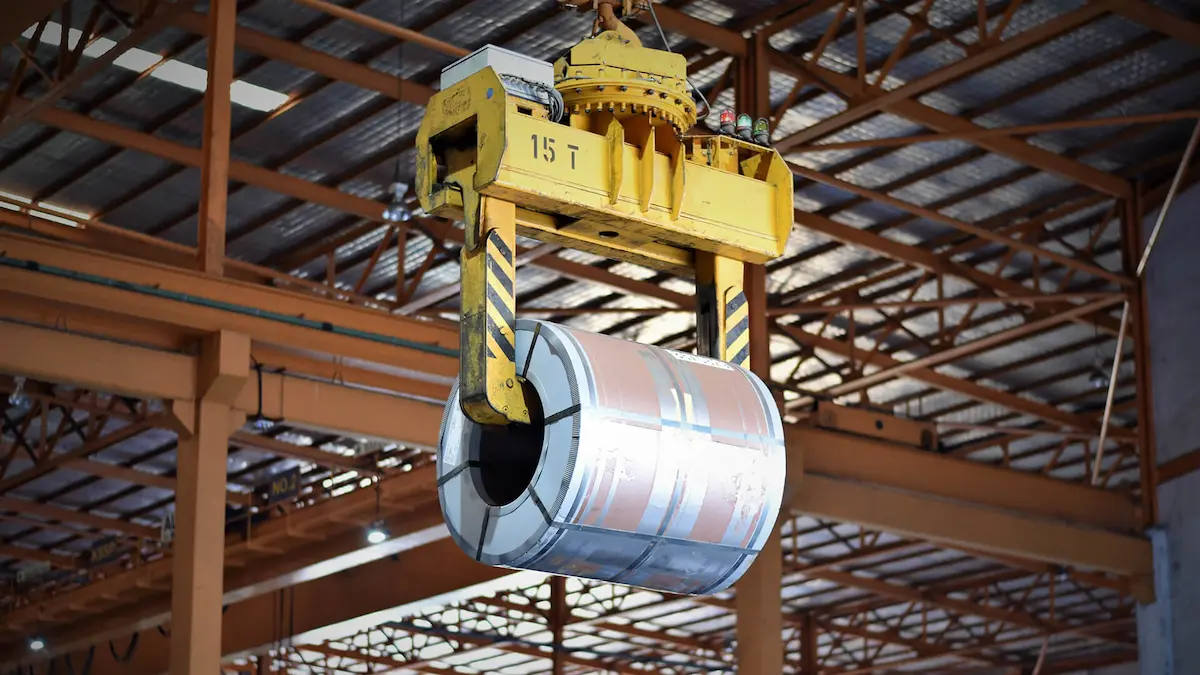
Working Principle of the steel coil tong
●Move above the coil: The crane moves the tong above the coil to be lifted. Operators confirm the tong center is roughly aligned with the coil center. Alignment sounds simple. But poor lighting and dense coil storage can cause offset clamping.
●Jaws lower and contact: The tong lowers until jaws are on both sides of the coil. Jaw contact surfaces approach the coil outer surface. Control the lowering height well. Do not let jaws hit the coil or ground.
●Jaws close: The electric clamping mechanism drives jaws toward the coil. During closing, observe whether jaws contact both coil sides evenly. Avoid one side receiving force first.
●Clamping force secures the coil: Jaws clamp the coil with a set clamping force. Clamping force is not better when larger. Too small may slip; too large may crush the surface. Set it by coil weight, surface condition, and contact material. Some equipment has clamping force display or alarm. This function is practical in actual use.
●Lift and transport: After confirming clamping is in place, the crane lifts and moves the coil to the target station. Lifting and travel must be smooth. Sudden stops and turns harm clamping stability.
●Release and unload: At the target, the clamping mechanism reverses and jaws open. The coil lands at the designated position to complete unloading. Before release, confirm support below the coil is in place. Avoid the situation where jaws release and the coil tips over.
Main Application Scenarios for the steel coil tong
●Horizontal steel coil handling: When the coil axis is horizontal, jaws clamp the outer circumference from both sides. It suits in-warehouse transfer, loading, and unloading. This condition is common. During selection, focus on coil diameter range and jaw opening.
●Vertical steel coil handling: When the coil stands vertically, clamping direction and outer circumference contact change. Requirements differ for jaw form and clamping force distribution. Some sites mix horizontal and vertical coils. Confirm whether the tong handles both postures, or use two solutions.
●Transfer between coil production lines: For coil turnover among decoiling, slitting, and annealing lines, cycle time is tight. Jaw closing speed, release efficiency, and crane coordination are important. Here, electric tong response and control directly affect production efficiency.
●Steel coil storage and loading/unloading operations: It is used for warehouse stacking, truck loading/unloading, and dock turnover. When storage space is tight, consider tong dimensions and operator visibility. Do not let the tong body block the operator’s view of the coil.
●Work areas requiring frequent changes in steel coil handling posture: This is where the steel coil tong has an advantage over the C-hook. If the site sometimes needs horizontal lifting and sometimes vertical transfer, the tong adapts better. However, frequent posture changes mean faster wear of clamping mechanism and pads. Shorten maintenance intervals accordingly.

Special Design Requirements for the steel coil tong
|
Design requirement |
What to consider |
Easily overlooked point on site |
| Clamping force matching coil weight | Set clamping force range by coil weight, surface condition, and jaw contact area. Keep a reasonable safety margin. | Setting only by maximum coil weight makes force too high for light coils. This may crush surfaces. |
| Jaw contact surface matching coil surface | Contact surface curvature, width, and material must match common coil outer diameters. Ensure sufficient contact. | With a wide coil diameter range, one curvature may fit well only for some specifications. |
| Anti-slip and protection design | Use protection pads, anti-slip patterns, or coatings. Balance clamping stability and surface protection. | If worn pads are not replaced promptly, anti-slip and protection effects both drop. |
| Clamping mechanism reliability | Electric drive, transmission parts, and jaw structure must withstand frequent opening/closing and load impacts. | Looking only at rated clamping force ignores fatigue from frequent starts and stops. |
| Coil release and fault handling mechanism | Normal release logic must be clear. Provide emergency release for power loss, signal loss, or abnormal clamping. | If emergency release steps are not trained, the site may not know how to respond. |
Steel Coil Handling Equipment: Differences Between C-hook and Steel Coil Tong
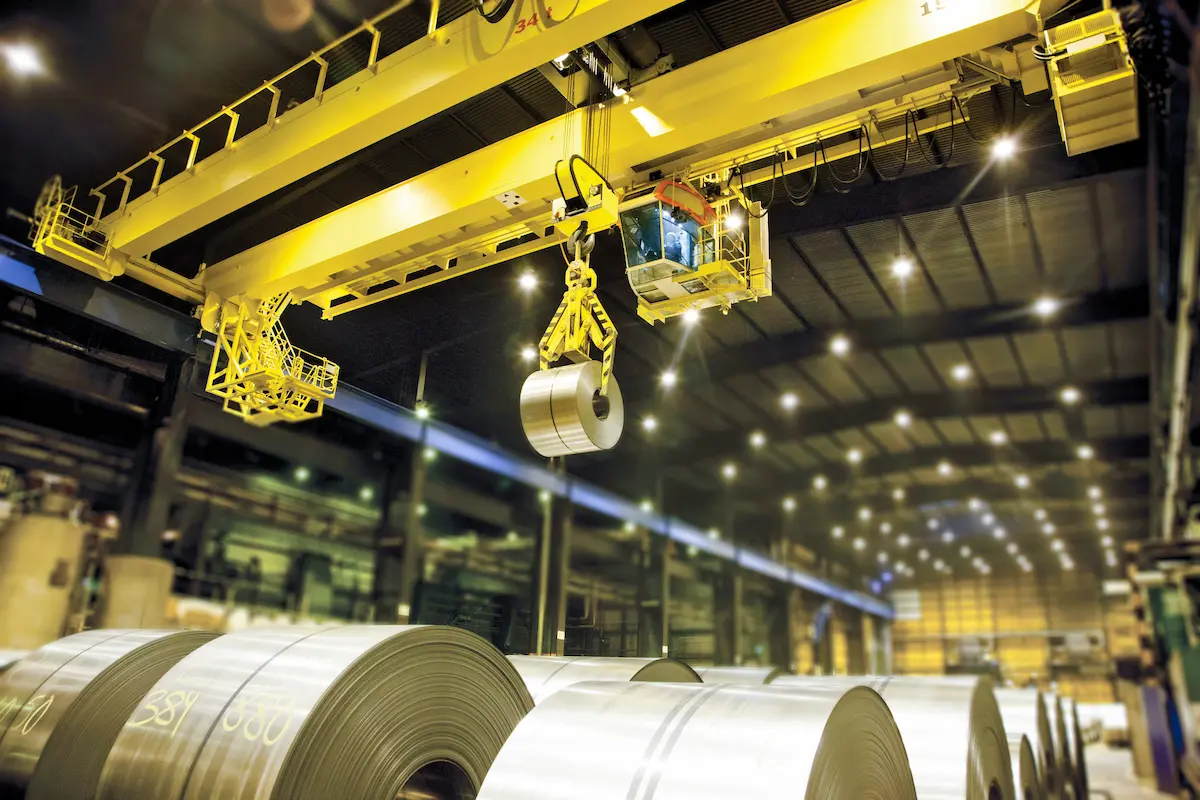
Neither type is absolutely better. Selection depends on coil placement, inner diameter stability, and posture-change frequency. Do not focus only on tonnage.
|
Comparison dimension |
C-hook |
Steel coil tong |
| Working principle | Load arm supports from inside | Jaws clamp outside by force |
| Main contact position | Coil inner diameter | Coil outer surface |
| Fixing method | Support lifting | Clamp lifting |
| Applicable posture | Mainly horizontal coils | Horizontal or vertical coils |
| Power requirement | Generally passive, no extra power | Electric jaws need power and control |
| Surface protection | Inner contact; load arm can add protection | Outer contact; use and replace pads |
| Size adaptation | Check inner diameter, width, arm size | Check diameter, width, jaw opening/range |
| Typical scenarios | Horizontal transfer, stacking, loading | Multi-posture handling, line transfer, mixed coils |
| Maintenance focus | Hook structure, arm wear, counterweight | Jaws, drive, clamping mechanism, pads |
| Selection focus | Inner diameter match and rated capacity | Clamping capacity, posture, surface protection |
A C-hook is simpler and suits stable inner diameters and mainly horizontal handling. A steel coil tong adapts better to mixed postures, but needs electrical and clamping maintenance. List actual conditions before choosing; avoid one-machine compromise.
How to Choose Suitable Steel Coil Handling Equipment?
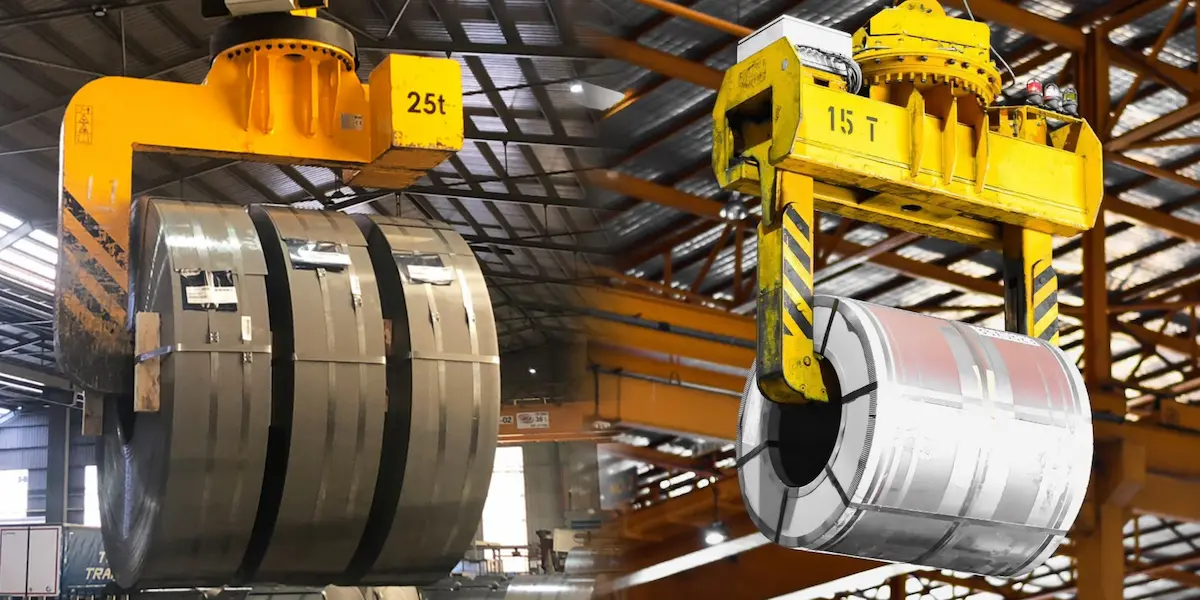
Do not start with price or tonnage alone in steel coil handling equipment selection. Clarify these items. Then manufacturer communication will be smoother.
●Choose rated capacity by coil weight: Count common and maximum single-coil weights first. Keep a reasonable margin. Do not back-calculate from an occasional maximum coil. Long-term critical use strains structures and clamping mechanisms. Check rated capacity for both C-hook and steel coil tong. Looking sturdy is not enough.
●Choose by coil inner diameter, outer diameter, and width: For a C-hook, check inner diameter and coil width. The load arm must insert and support stably. For a steel coil tong, check outer diameter range and jaw opening. List specifications for wide inner diameter spans and inconsistent widths. Not one “average size.”
●Choose by coil placement direction: A C-hook suits mainly horizontal coils, transfer, and stacking. If horizontal and vertical coils mix, or posture changes often, prioritize a steel coil tong. This item is easiest to misselect. Show incoming posture photos to the manufacturer.
●Choose by working environment and use frequency: High temperature, dust, outdoor docks, and clean workshops differ. For high-frequency work, check jaw closing speed, pad replacement cycle, and hook counterweight. Maintenance convenience matters more than paper data.
●Match existing crane configuration: Confirm crane rated capacity, hook specifications, lifting height, and power conditions. For electric tongs, plan cable reel or drag chain and control cabinet location. For a C-hook, check spreader plus coil weight against crane capacity. Do not discover connection or power problems after arrival.
HSCRANE Steel Coil Handling Equipment Advantages
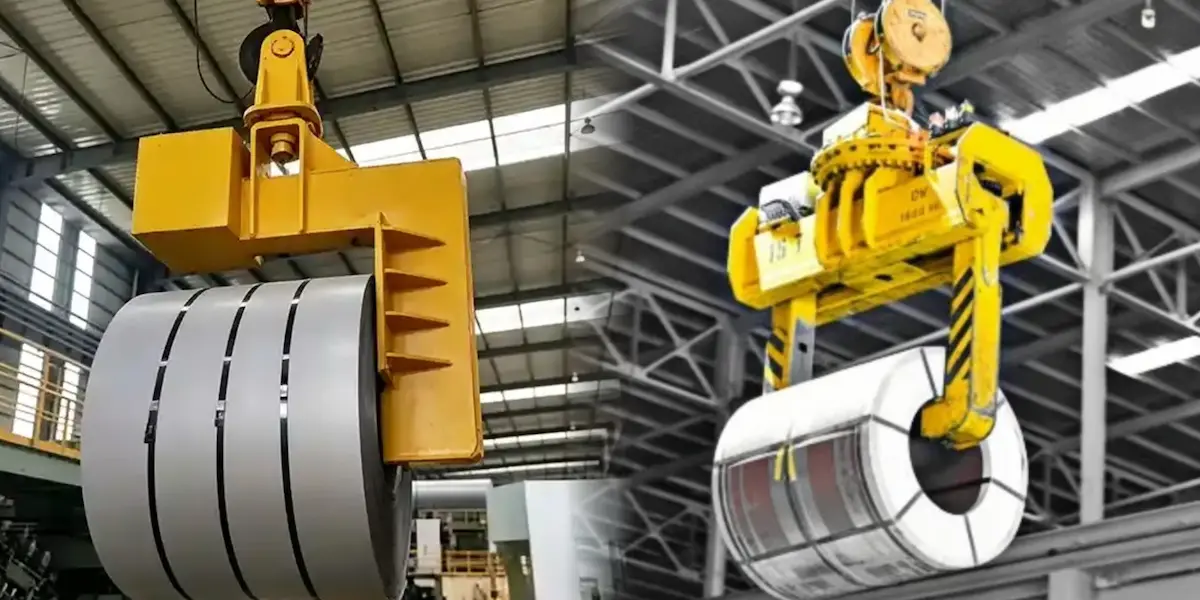
●Complete crane matching has a documented basis: C-hook matches double-girder overhead, metallurgical overhead, and gantry cranes. Crane class follows ISO 4301-5:2025 for cycles and load spectrum. Mechanism class references FEM 9.511 M3–M8. This avoids spreader-lifts-but-crane-fails mismatch.
●Workshop layout is derived from actual dimensions: Lifting height, span, and travel range follow building clearance, rail position, stacking height, and aisles. For C-hook, calculate load-arm insertion stroke and visibility. Wrong span makes use awkward.
●Spreader self-weight is included in crane capacity: C-hook counterweight and arm, plus steel coil tong frame and jaws, add weight. Compare spreader plus coil against crane rated capacity, not coil tonnage alone.
●Electric steel coil tong power and control are matched in advance: Follow EN 13135:2026 safety principles. Put clamping force, release logic, and emergency operation into drawings at proposal stage, not temporary wiring on arrival.
●Design follows production pace from machine to flow: Mill pace, storage, and routes determine spreader type, crane speed, positioning accuracy, and quantity. We view C-hook or steel coil tong within the whole steel coil handling flow.
●Design, manufacturing, inspection, and delivery follow one line: Complete cranes can be safety-assessed under EN 15011:2020. Inspection follows ISO 9927-5:2017. Wire ropes follow ISO 4309:2017. At delivery, clarify checks and replacements.
HSCRANE Classic Project Cases: Steel Coil Handling Crane Solutions
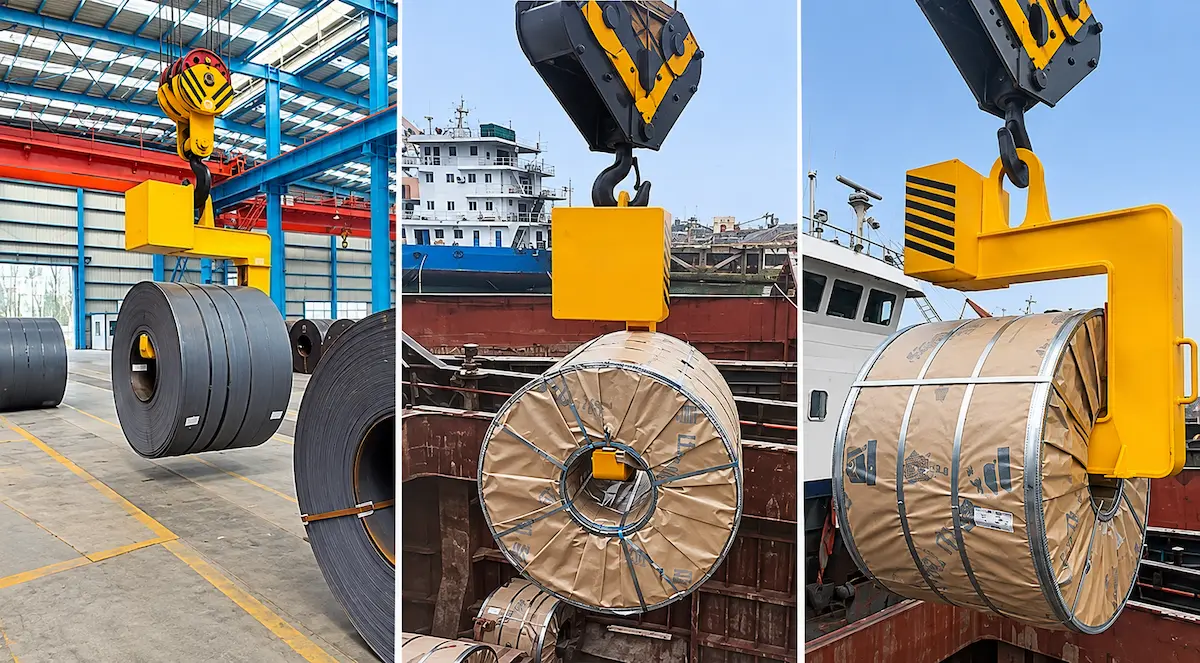
Saudi Arabian Steel Mill: 16-ton Double-Girder Gantry Crane C-hook Project
●Customer and background: The client is a large steel processing enterprise in Jubail Industrial City. Jubail is a core heavy-industry area in eastern Saudi Arabia. Local steel mills face capacity pressure from Middle East infrastructure projects. They also face outdoor conditions above 50°C and frequent dust. The customer’s original A4-duty equipment stopped frequently in hot periods. Contactors failed repeatedly due to fine dust, becoming a capacity bottleneck.
●Equipment configuration: HSCRANE delivered one MG-type 16-ton double-girder gantry crane. Span is 28 m for two-lane yard loading and unloading. Lifting height is 12 m, and duty class is raised to A6. Lifting speed is 6.5 m/min; long travel speed is 35 m/min. Main hoisting uses metallurgical wire rope and heavy forged hook. A C-hook handles outdoor loading and unloading of coils and billets.
●Targeted design: Motor and electrical cabinet protection is raised to IP55. Motors use Class H insulation. All inverters and core components are in a double-insulated cabinet. The cabinet has industrial air conditioning and dust filter. Micro-positive pressure design blocks fine dust in Jubail. The cab is a panoramic aviation-grade insulated cabin with anti-glare glass. At 50°C continuous outdoor work, operating environment matters. Even good parameters fail without a solved operating environment.
●A plain truth: The most valuable reference is not tonnage but environmental adaptation. For Middle East outdoor yards, C-hook passive balance is not complex. If crane electrical protection and heat dissipation lag, failures eat efficiency.
Ecuador: 30-ton Double-Girder Overhead Crane Steel Coil Tong Project
●Customer and background: The customer is a local steel structure and machinery manufacturer in Guayaquil. Its business covers large steel components and hydropower station parts. The plant is coastal with high humidity and salt-fog corrosion risk. It frequently lifts extra-long or heavy beam components. Original equipment lacked stability and micro-speed control.
●Equipment configuration: The selected unit is a QD-type 30-ton double-girder overhead crane. Main hook capacity is 30 tons; span is 22.5 m, customized to building column spacing. Lifting height is 12 m; duty class is A5/M5. Power supply is 440V/60Hz/3Ph; main lifting speed is 3.5 m/min. The crane uses box-girder structure; finite element check keeps static deflection within L/700. Full-crane VFD control supports micro-speed operation for lifting and travel. Per user outline, a steel coil tong handles multi-posture transfer of coils and heavy components.
●Site adaptation: Guayaquil salt fog is harsh to steel structures. Anti-corrosion primer is epoxy zinc-rich; topcoat is polyurethane. Total film thickness exceeds 120 μm. The 23 m main girder ships in sections and is bolted on site. This reduces sea shipping and on-site lifting difficulty. PLC preprogramming and modular wiring raised on-site wiring efficiency by about 30%. Before delivery, 125% static load (37.5 tons) and 110% dynamic load tests were done. The customer signed acceptance after data met requirements.
●Operation feedback: After commissioning, component turning and transfer time dropped by about 40%. Travel energy consumption fell by about 15%. The customer’s comment on 30-ton crane stability was direct. When lifting irregular steel frames, micro-speed control gives operators more confidence than parameter tables.
Summary
The difference is simple: a C-hook supports the coil from the inner diameter; a steel coil tong clamps it from outside. The C-hook suits stable inner diameters, mainly horizontal transfer and stacking, with simple structure and few maintenance points. The steel coil tong handles horizontal and vertical coils, but needs more attention to electric clamping, protection pads, and power control. When selecting, do not compare tonnage only. List coil inner/outer diameter, width, placement direction, operating frequency, and crane configuration. Then choose one type or a combination. For safety, do pre-shift checks, replace worn pads promptly, and do not ignore abnormal wear or clamping force drop. A spreader problem costs more than saved time.
Looking for Reliable Steel Coil Handling Solutions?
HSCRANE provides C-hook, steel coil tong, and matching overhead and gantry crane solutions. We customize by coil weight, size, handling method, and production environment. Whether for storage, production lines, or large loading/unloading, we can help evaluate suitable spreader and crane configurations.
[Contact the HSCRANE technical team for the best solution]
Further Reading: Differences Between Billet Spreaders and Coil Spreaders
If a workshop lifts both coils and billets, do not copy selection logic directly. Coil spreaders focus on inner diameter, coil width, and posture. Billet spreaders focus on shape, length, and high temperature. This comparison article puts application scenarios and selection points together.
Click to view: [Billet Spreader vs. Coil Spreader: Key Differences and How to Choose the Right One]
Steel Coil Handling Equipment FAQ
Q1: Can a C-hook lift vertical coils?
No. A C-hook supports from the inner diameter. It handles horizontal coils. Vertical coils change force and balance. Sway risk rises. For vertical coils, use a steel coil tong. Use separate spreaders by posture. Do not expect one C-hook to cover all.
Q2: Can a steel coil tong damage the coil surface?
Yes, clamping has a crush risk. Jaw contact areas use protection pads or coatings. Match clamping force to coil weight and surface. More force is not better. Replace pads before wear-through. For high surface needs, confirm pad material and replacement cycle.
Q3: How should I select a C-hook when coil inner diameters vary?
Set load arm size by common inner diameter range. Confirm capacity at maximum weight and width. Ask if one C-hook can cover it. Do not report only an average inner diameter. Large coils may fit; small coils sway.
Q4: How is the coil released if an electric steel coil tong loses power?
Ask this during steel coil handling equipment selection. Proper designs include emergency or manual release. Operators must know simple release steps. Train them before use. Ask the supplier directly.
Q5: Can a C-hook and a steel coil tong be used interchangeably?
No. One supports the coil; the other clamps it. They need different posture and crane matching. Power, control, and operating habits also differ. Choose main equipment by main working conditions. Use dedicated spreaders for other conditions.
This document is for reference only. Specific operations must strictly comply with local laws and regulations and equipment manuals.