

Overview
The crane end carriage is not just a support base. In bridge and gantry crane systems, it acts as a core hub. It precisely connects main girders, travel mechanisms, wheel sets, and tracks. Many clients focus solely on main girder sections during selection. However, they often underestimate the importance of the end carriage.
Actually, the end carriage design directly determines the overall running stability. It must stably support huge static and dynamic loads. It also safeguards geometric precision and overall equipment safety. A weak end carriage stiffness or poor wheel span affects running. Substandard assembly precision also makes the equipment struggle to operate. This article systematically breaks down key details behind end carriage design. We detail core factors that invisibly affect the crane running status.
Does your crane often show body deflection or severe track gnawing? Does it have abnormal vibration during startup or braking?
Do not just check wheels and tracks for faults. The end carriage structural stiffness and wheel configuration are root causes. The factory manufacturing precision also fundamentally affects running stability.
[Click to contact HSCRANE for end carriage selection and optimization plans]
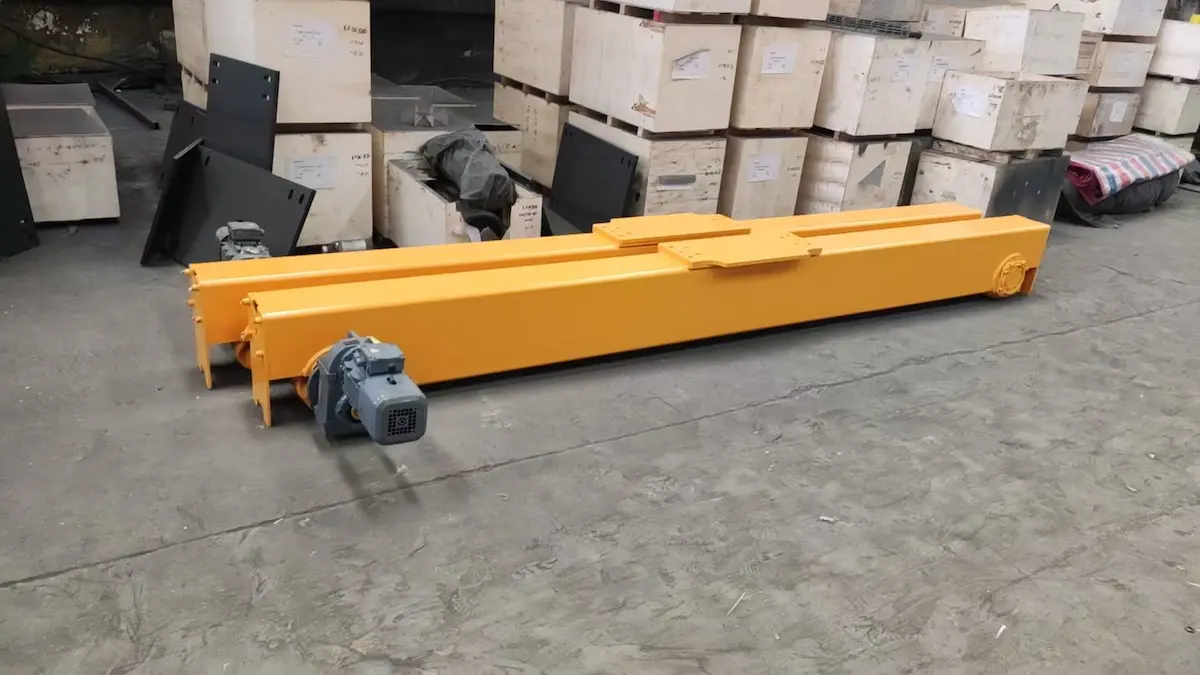
Key Crane End Carriage Design Factors Affecting Running Stability
Crane maintenance engineers know travel stability depends heavily on the base. A well-built end carriage is crucial for stable crane operation. When evaluating or designing a crane end carriage, we focus on these indicators:
●Overall end carriage structural stiffness: This is the load-bearing foundation. Without enough section stiffness, the end carriage twists slightly under full load. Eccentric loads from the main girder will make the crane float.
●Workshop manufacturing and boring precision: Welding deformation must be heavily controlled. End carriage bending and boring concentricity determine initial wheel alignment. A tiny deviation causes immediate rail gnawing upon installation.
●End carriage and wheel set wheelbase match: Wheelbase must strictly match span. The end carriage wheelbase ratio is usually 1/6 to 1/8. A short wheelbase easily causes snake-like crane movement.
●Tolerance adaptability for running tracks: On-site tracks have inherent height errors. A premium end carriage design absorbs these flaws effectively. It uses reasonable wheel assembly structures like angular bearing boxes.
●Span and force distribution: Connecting nodes determine the force transmission path. Uneven forces cause long-term unilateral wheel overload and break mechanical balance.
●Main and end carriage connection method: High-strength bolts are currently mainstream. Insufficient joint stiffness causes displacement and misalignment during heavy starts.
●Weight and center of gravity layout: The shift in end carriage center of gravity is harmful. It ruins friction allocation and causes unilateral slipping during startup.
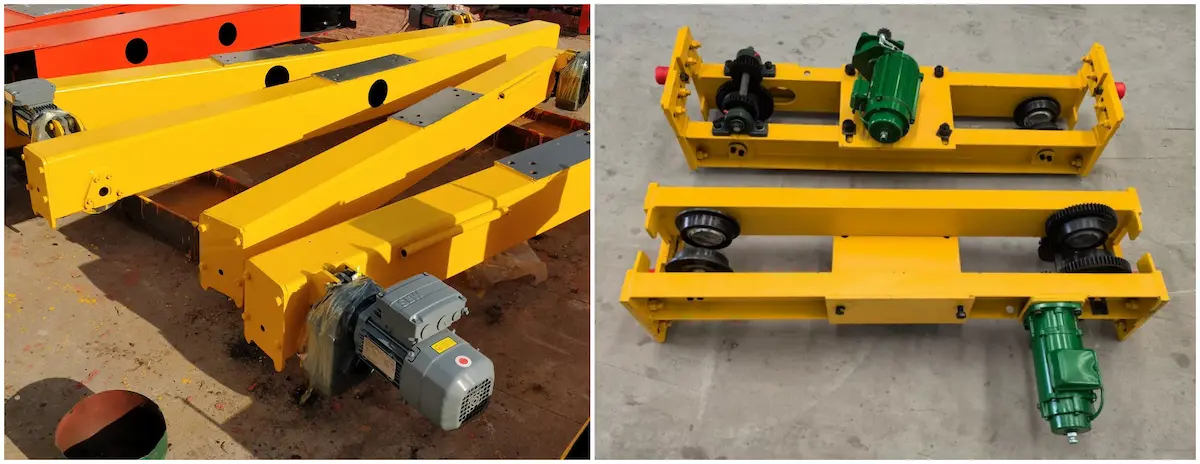
What Operational Problems Arise from Unreasonable End Carriage Design?
If the crane end carriage has flaws during the design stage, late maintenance cannot cure them. Adjusting wheels or adding shims only treats the symptoms. This innate deficiency exposes fatal pain points in actual workshop operation:
●Crane travel deflection: This is the most intuitive visual issue. Unequal driving resistance or improper wheel span causes slanted running. The crane moves diagonally like a crab instead of straight.
●Vicious rail gnawing and iron flakes: Wheels clash hard with steel tracks. Harsh friction causes track edge metal peeling and wheel flange thinning. The wheel flange can even break in a very short time.
●Violent vibration during startup or braking: A weak end carriage fails to absorb shocks. Inertial shocks cause obvious shaking and dangerous pendulum-like load swaying.
●Running noise significantly exceeds standards: Force deformation causes abnormal rail gnawing sounds. It also causes poor gear meshing and high-frequency mechanical noise.
●Sharp drop in component lifespan: Wheels, tracks, and bearings suffer abnormal forces. Due to constant torque and lateral forces, they fail within months.
●Increased operating mechanism maintenance frequency: Frequent shutdowns drag down daily production pace. You constantly need to tighten connecting bolts and replace worn parts.
●Long-term operation causes hidden safety risks: Abnormal deflection and high-frequency vibration accelerate fatigue damage. This induces end carriage weld cracks and potential derailment rollover risks.
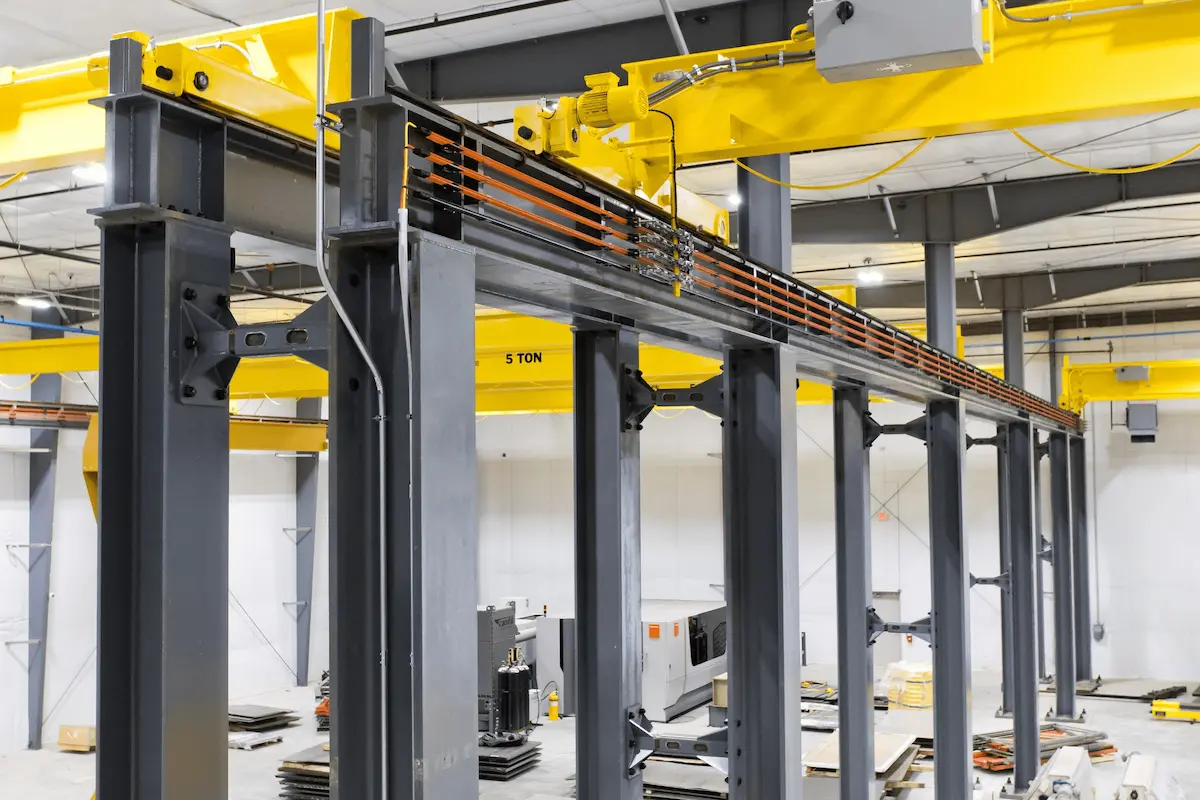
How to Improve Stability Through Crane End Carriage Design?
You cannot rely on late on-site debugging for stable travel without rail gnawing. Problems must be stopped at the drawing and manufacturing stages. In practice, we focus on details through these four steps:
Optimize End Carriage Structure Design
●Customized structural deduction: Designing without actual working conditions is irresponsible. We avoid one-size-fits-all approaches. We deduce the required end carriage stiffness and strength boundaries. We strictly base this on rated capacity, main girder span, and working class.
●Section size and stiffener layout: For box structures, web and flange thickness ratios must be reasonable. We scientifically arrange internal stiffeners at the most stressed nodes. These include the main end carriage connection and wheel installation positions. This improves overall stiffness and ensures uniform load distribution. It also prevents local stress concentration.
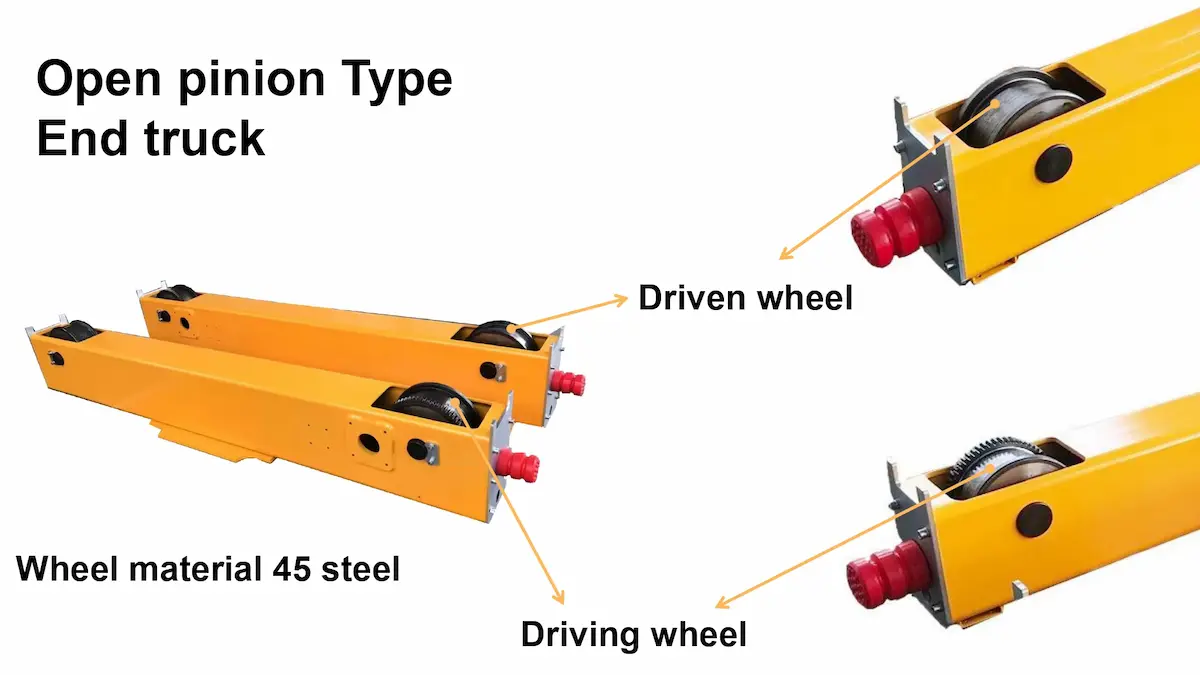
Improve Manufacturing and Assembly Precision
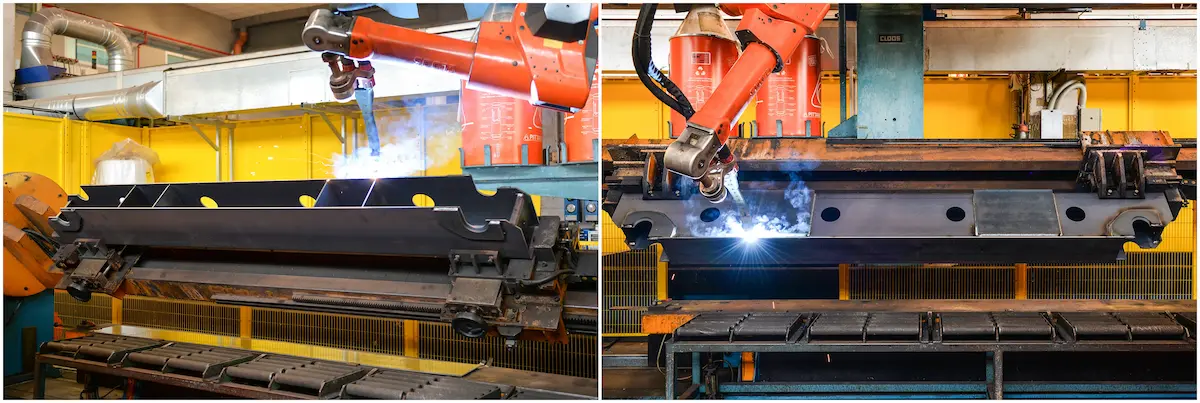
●Control end carriage welding deformation: End carriage welding easily causes thermal deformation. We use automated tailor welding with a reasonable welding sequence. We perform post-weld stress relief when necessary. This ensures the end carriage never leaves the factory defective.
●Overall boring process for wheel assembly: This is key to preventing rail gnawing. Instead of installing wheels then fine-tuning, we do overall boring. We clamp the end carriage once on a large CNC machine. This fundamentally guarantees wheel hole concentricity and parallelism at both ends.
Optimize Wheel and Operating Mechanism Configuration
An excellent crane end carriage structure needs a matching operating mechanism. To make it more intuitive, we summarize this configuration logic:
|
Optimization Dimension |
Design/Matching Principle |
Intuitive Effect |
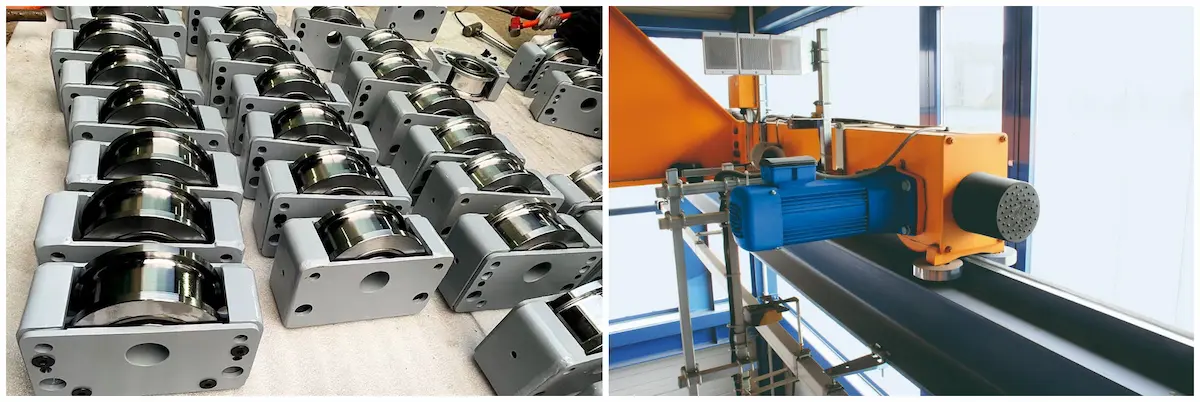
| Wheel Matching | Scientifically calculate based on maximum wheel load. Choose appropriate wheel diameters and materials. Example: forged steel surface heat treatment. | Avoid excessive wheel loads damaging the track. Extend the wheel service life. |
| Drive Method | Abandon old open gears. Prioritize three-in-one geared motor direct drives. This refers to hollow shaft direct connection. | High transmission efficiency and extremely smooth operation. Eliminate the trouble of frequent lubrication. |
| Sync Control | Standardize variable frequency drive (VFD) systems. Ensure absolute synchronous motor speeds on both sides. | Smooth starts and braking without impact. Eliminate crabbing and swinging caused by unilateral lag. |
Conduct Factory Running Tests
An untested end carriage cannot be shipped. At the HSCRANE test bench, every device must pass three tests before leaving:
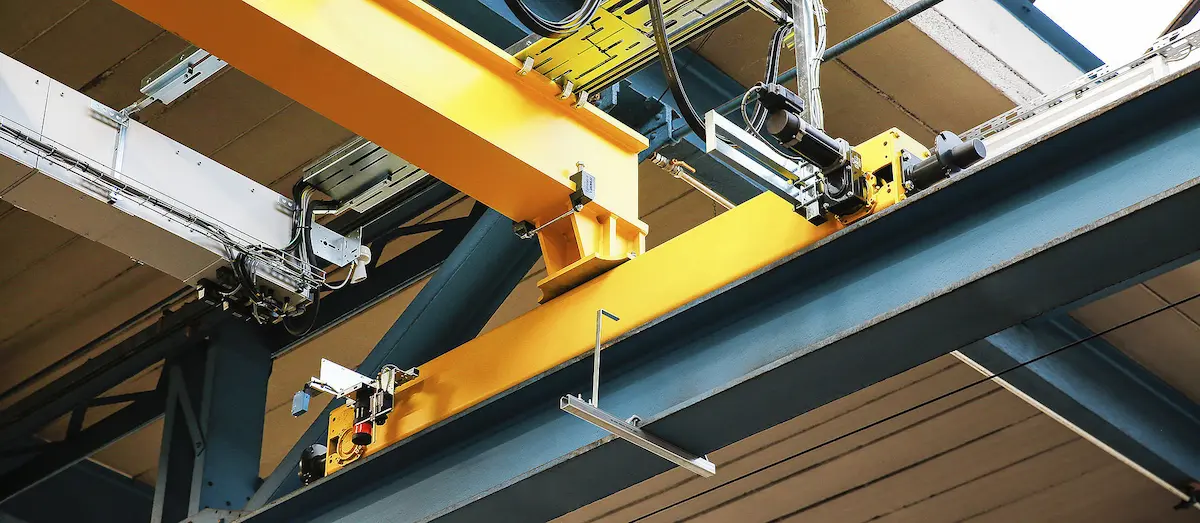
●No-load and rated load travel: We simulate a real track environment. We observe deflection changes after bearing loads.
●Startup/emergency stop limit tests: We frequently start, brake, and reverse. We check for abnormal impact noises caused by mechanical margins.
●Deflection and vibration capture: We use laser tracking equipment. We check if high-speed deflection rates stay within design tolerances.
Are you designing a bridge crane for a new plant? Or do you want to upgrade old equipment?
HSCRANE has over ten years of non-standard custom experience. We provide tailored crane solutions based on your parameters. These include capacity, span, working class, and site track conditions.
[Click here to submit your technical parameters], and get technical plans and quotes from HSCRANE engineers within 24 hours.
What Are the Crane End Carriage Design Differences Under Various Conditions?
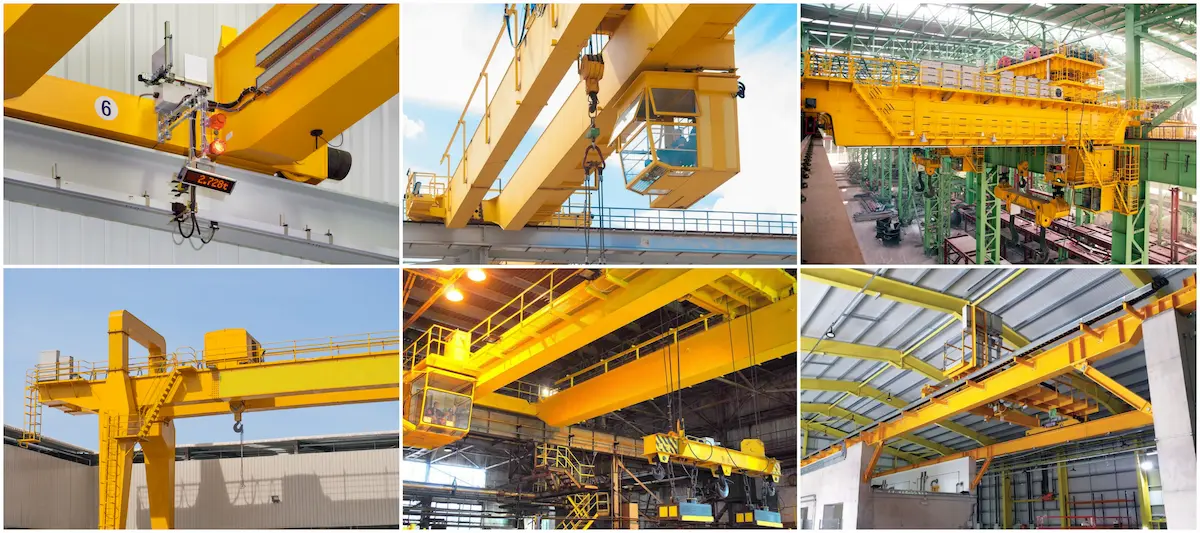
Crane application scenarios vary greatly. A universal crane end carriage design fails. A standard workshop end carriage in a steel mill breaks quickly. Here are core end carriage design differences across conditions:
|
Application Scenario |
Common Crane Type |
Core End Carriage Design Needs and Differences |
| Standard Machining Workshop | Single/Double Girder Bridge Crane | High cost-effectiveness and lightweight design. Meets standard A3-A5 working classes. Prioritizes compact box girders and angular bearing boxes. Balances daily running smoothness. |
| Heavy Machinery / Shipyard | Heavy Bridge Crane | Super strong stiffness and heavy wheel load distribution. Ultra-large tonnages require multi-wheel bogies. These include 4, 8, or more wheels. This disperses huge track damage. |
| Metallurgy / Hot Casting | Foundry / Metallurgical Crane | Resistance to heat radiation and thermal deformation. The end carriage bottom needs a heat insulation layer. Steel requires high-temperature yield characteristics. Bearings and lubrication need special high-temperature configurations. |
| Outdoor Yard / Port | Gantry Crane | Wind and lateral force resistance. Large wind areas and settlement demand reinforcement. It needs windproof anchors like rail clamps. Wheels must adapt to poor track tolerances. |
| Waste / Continuous Work | Grab / Electromagnetic Crane | High-frequency fatigue life (A7-A8 class). It runs 24 hours continuously. End carriage welds require 100% non-destructive testing (NDT). Fatigue calculations are extremely demanding. Motors and reducers need increased margins. |
| Large Span Aviation / Assembly | Ultra-Large Span Bridge Crane | Anti-deflection and high synchronization. Spans over 30 meters easily cause asynchronous movement. The end carriage design needs high-precision flexible hinges. It also requires advanced electrical correction systems. |
How to Judge Whether Crane End Carriage Design Is Reasonable?
Many buyers only check paint and lifting capacity during crane acceptance. Actually, the crane end carriage health condition can be judged by several key indicators. We recommend checking these during the equipment commissioning stage:
●Structural strength and stiffness performance: Stand beside the end carriage when the fully loaded crane runs to mid-span. A well-designed end carriage shows minimal horizontal and vertical deflection under full load. Visible twisting or bending indicates insufficient cross-sectional margin.
●Wheel load distribution test: Use a wheel load tester to check if wheel forces are uniform. Reasonable force distribution avoids long-term floating or overloading on any wheel. Otherwise, local tracks can easily be crushed.
●Geometric dimensions and assembly diagonals: Measure the wheel span and diagonal error using tapes and laser meters. According to national standards, exceeding diagonal tolerances dooms the crane to slanted travel.
●Listen to sound to detect rail gnawing: Run the crane back and forth three times at full speed. Sharp friction sounds or bright razor scratches and iron flakes show design failure. This indicates inadequate end carriage wheelbase or wheel concentricity design.
●Vibration and startup or braking smoothness: Observe if the travel mechanism sways severely during quick starts or stops. Check for dull metal impact sounds. Smooth operation should be completely seamless.
●Maintenance cycle review: Bearings making noise within six months or gearboxes leaking oil indicate end carriage deformation. Deformation twists the transmission chain, rooting the problem entirely in the end carriage structure.
HSCRANE Crane End Carriage and Complete Product Advantages
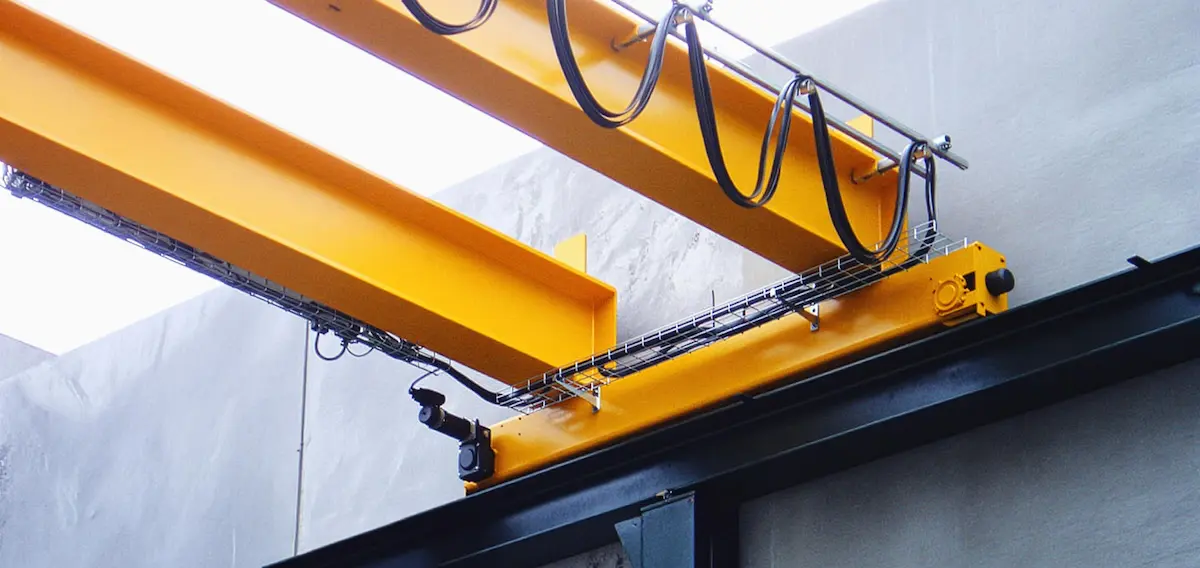
Making a crane is easy. Building a crane that runs smoothly for ten years is hard. HSCRANE avoids guesswork in crane end carriage design and manufacturing. We strictly align with international standards and implement specific clauses:
●Execute FEM & EN structural design standards: Section and plate thickness calculations strictly follow EN 13001-3-1 and FEM 1.001 Booklet 2. We reject material stacking and focus on scientific fatigue design.
●Extreme manufacturing tolerance control: We enforce Class 1 tolerance under ISO 12488-1:2012 for wheel and track tolerance matching. After welding, end carriages undergo one-time clamping processing on CNC boring machines. This completely eliminates wheel deflection.
●Seamlessly match operating mechanisms: Geared motors, wheel sets, and end carriage holes use high-precision interference fits. This meets ISO 2768-m machining standards and ensures zero power transmission loss.
●Extremely strict factory quality inspection: Welds undergo 100% non-destructive testing under EN 1090-2. Every end carriage set undergoes variable frequency synchronization testing before shipment. This prevents defective products from entering customer sites.
●All-condition customization capability: Whether explosion-proof, metallurgical, or ultra-large span, we provide tailored non-standard solutions.
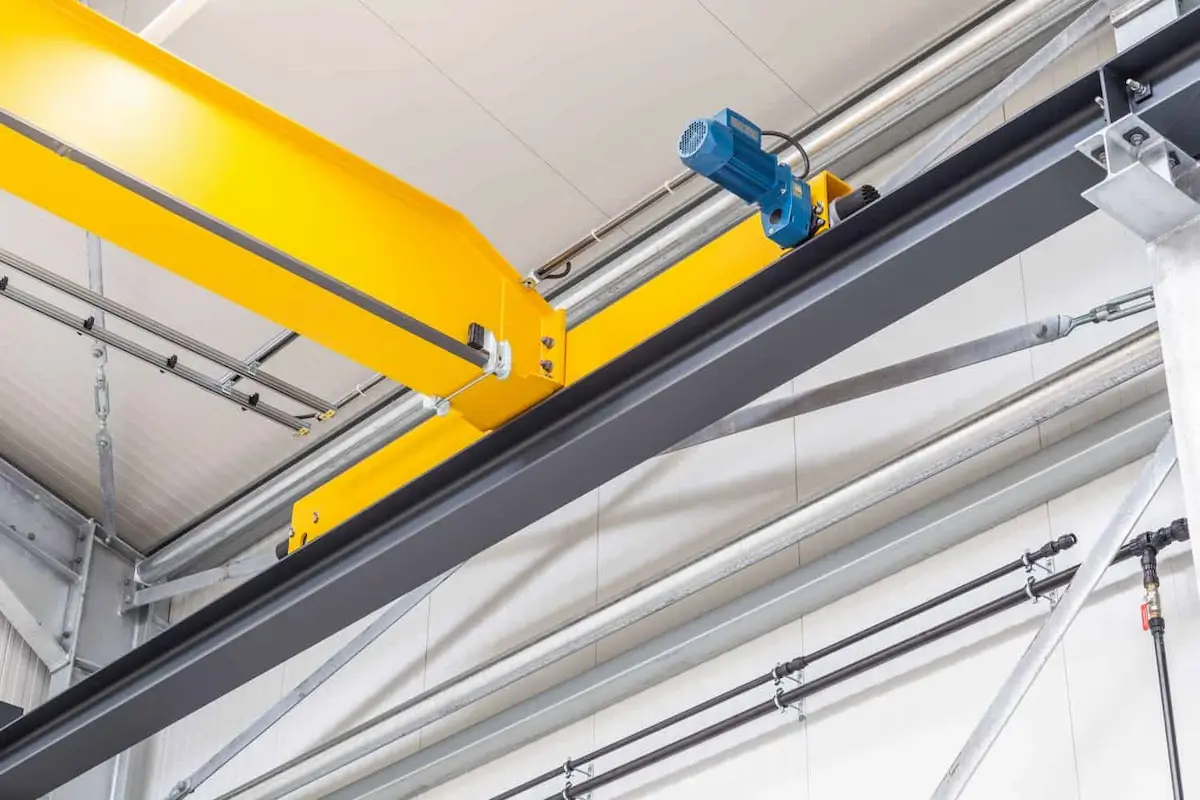
HSCRANE Classic Case: Improving Crane Running Stability Through End Carriage Optimization
●Project background: Hot rolling workshop expansion project of a large steel group in Vietnam (Hoa Phat Group).
●Equipment parameters: Three 75t/20t double girder bridge cranes, 31.5m span, A7 working class, 24-hour continuous operation.
●Customer pain points: Old plant cranes suffered severe slanted running and rail gnawing due to large spans and harsh conditions. Wheel flanges wore flat every 4 to 6 months and required replacement. Track clamps broke frequently, severely impacting hot rolling production delivery.
●HSCRANE design solution: For ultra-large spans and high-frequency heavy loads, we abandoned traditional four-wheel end carriages. We custom-designed an eight-wheel equalizer bogie end carriage. Paired with Siemens closed-loop VFD and photoelectric deviation correction, it evenly distributed maximum wheel loads of 420kN.
●Core manufacturing process: We selected Q355ND low-alloy high-strength structural steel. Bogie articulation points underwent high-frequency quenching. After welding, the end carriage body was stress-relieved in a large annealing furnace at 600°C. Precise machining on CNC boring machines ensured wheel hole distance errors stay under 0.5mm.
●Testing and site acceptance: After assembly in Vietnam, laser total stations measured the diagonal deviation. The 31.5m span diagonal deviation was only 2.1mm. This was far below the ISO allowed limit of 5mm.
●Delivery and operational results: Equipment has run for 18 months with zero wheel replacements or track peeling. Travel noise dropped by 15%, and annual travel mechanism maintenance costs decreased by 45%. The plant manager noted: “This is the quietest heavy crane running in our workshop.”
Conclusion
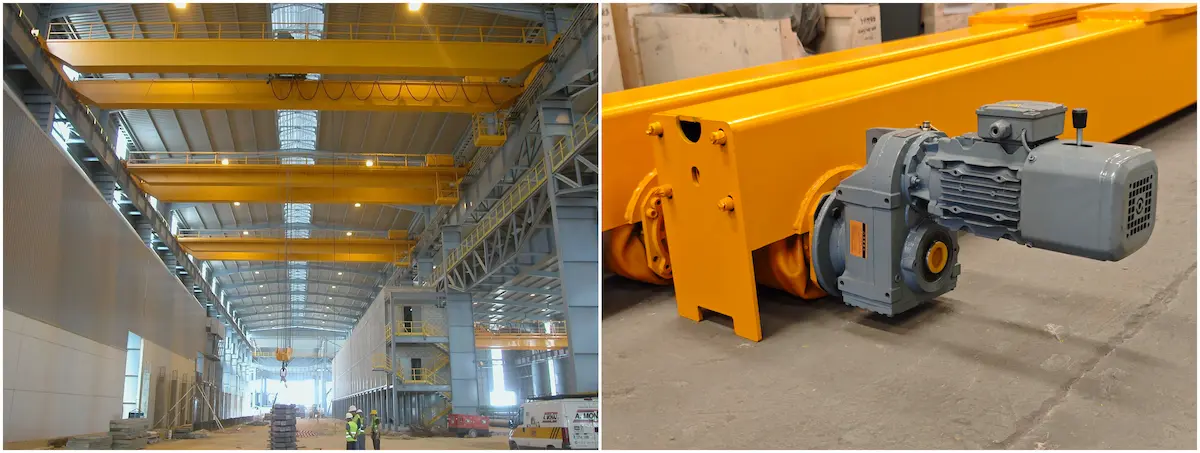
A crane end carriage is never just welded iron. It is the chassis and framework for smooth operation. We have seen many painful lessons over the years. Cheap designs ignore end carriage stiffness and boring precision. This causes severe rail gnawing and shutdown at sites. Maintenance teams then work overnight replacing wheels daily.
Mastering end carriage design and processing precision extends lifespan. It reduces future troublesome downtime and maintenance costs early. Do not just focus on main girder thickness. End carriage and travel mechanism matching decides overall durability.
Need a truly stable, efficient, non-gnawing crane?
From fatigue-resistant end carriage structures to precise manufacturing, we reject compromises. HSCRANE provides integrated crane solutions that stand time.
[Contact us immediately] to get custom technical drawings and parameters. Get your transparent project quotation today.
Further Reading: Thoroughly Understand the Crane Chassis
The crane end carriage is the chassis determining stability. Ignoring stiffness and precision leads to deflection and gnawing. It also causes severe abnormal running noise. We summarized years of practical experience into an in-depth guide. It covers end carriage stiffness, CNC boring, and industrial applications. Click below to understand all crane end carriage design details:
[In-Depth Article: Everything You Need to Know About Crane End Carriages]
FAQ
To avoid pitfalls, we compiled common selection and maintenance questions:
Q: What steel plate material is recommended for manufacturing a crane end carriage?
A: It depends on your working conditions. Standard Q235B carbon steel suits light-to-medium workshops (A3-A4). For heavy-duty duties (A5+), we recommend Q355B or Q355ND steel. Its higher yield strength improves fatigue and impact resistance. This greatly reduces end carriage cracking risks.
Q: How often should wheel sets on the end carriage be replaced?
A: Wheels usually last 3 to 5 years under normal conditions. Rail gnawing indicates severe end carriage design or assembly issues. In that case, wheel flanges wear out within months. Thus, frequent wheel replacement is a structural problem, not consumables.
Q: Can adjusting end carriage wheels fix rail gnawing noise during travel?
A: It depends on the root cause. Minor early misalignments can be corrected by adjusting bearing boxes. However, wheel adjustment cannot fix insufficient end carriage stiffness. Permanent bending causes deformation to recur under heavy loads. In such cases, end carriage reinforcement or replacement is necessary.
Q: What is the difference between single and double girder crane end carriage designs?
A: Differences are significant. Single girder crane end carriages are lightweight and compact. Main girders connect directly using high-strength bolts and flanges. Double girder crane end carriages bear much higher wheel loads. They require internal stiffeners for high torsional stiffness. Connections use robust seated or shear-plate bolted joints.
This document is for reference only. Specific operations must strictly comply with local laws and regulations and equipment manuals.